xLandscape Training
Welcome
Welcome to the xLandscape Training documentation — Hands-on Landscape-based Ecological Risk Assessment using the Open Source xLandscape Modelling Framework.
This training covers an introduction and practical application of the xLandscape modelling framework, with a focus on landscape-scale ecological risk assessments of pesticides. The training is divided into three topic areas, each addressing a specific organism group and the corresponding xLandscape model.
Intro slide deck: SETAC xLandscape Training - (0) Training Intro
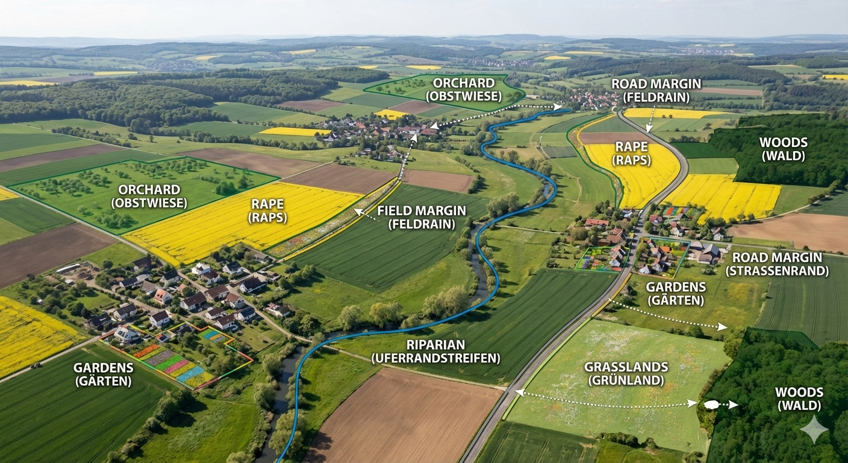
Dealing with questions around cultivated landscapes is the heart of the xLandscape development goals (ai generated, T Schad)
Training Topics
Aquatic Invertebrates
Landscape-level aquatic risk assessment for invertebrate species using the xAquaticRisk model. Topics include pesticide use, exposure of aquatic systems due to spray-drift deposition, environmental fate of pesticides in stream networks, and effects to organisms using TKTD models (GUTS).
Go to Aquatic Invertebrates training →
Aquatic Plants
Landscape-level aquatic risk assessment for aquatic plants (algae, macrophytes, lemna) using xAquaticRisk configured for aquatic plants. Topics include exposure modelling in surface water (spray-drift, drainage) and effect assessment for aquatic plants.
Go to Aquatic Plants training →
Pollinators
Landscape-level risk assessment for pollinator populations using the xPollinator model. Topics include exposure of honeybees to pesticides in agricultural landscapes and population-level effect modelling.
About xLandscape
xLandscape is an open-source, modular framework for spatiotemporally explicit landscape modelling. It integrates a range of ecological and environmental process models as interoperable components, enabling comprehensive risk assessments at the landscape scale.
Prerequisites
The course is on introductory level. Basic familiarity with ecological risk assessment concepts and pesticide regulation are helpful but not required. Also, no prior programming experience is needed.
Contact
For questions or further information, please contact:
Thorsten Schad — thorsten.schad@landwerk-ev.de
Sascha Bub — sascha.bub@rptu.de
Julian Heinrich — julian.heinrich@bayer.com
Sebastian Multsch — sebastian.multsch@basf.com